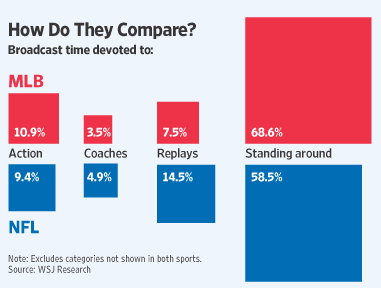
As Major League Baseball's postseason begins Wednesday, the sport's fans are prepping for what they'd call the most drama-packed month of the year—a time when families huddle around the television to see upsets pulled, heroes born and a World Series won.
The Anatomy of a Baseball Broadcast
As Major League Baseball's postseason begins Wednesday, the sport's fans are prepping for what they'd call the most drama-packed month of the year—a time when families huddle around the television to see upsets pulled, heroes born and a World Series won.
Associated Press
MIAMI — Norman Braman, a former owner of the NFL's Philadelphia Eagles, opposes a giant $3-billion (U.S.) public works deal that includes a long-sought stadium for baseball's Florida Marlins.
Braman is suing to stop Miami's so-called "global agreement" in its tracks, contending it was illegally hatched in secret and improperly uses money intended to cure urban blight and help poor people. Braman wants voters to decide projects of such magnitude, rather than politicians.
"Taxpayers in this town have been ripped off constantly over the years," Braman said in a recent interview in his downtown Miami office. "It's time that as citizens of this community that we say enough is enough — that we're not going to put up with this any more."
The 37,000-seat, retractable-roof Marlins stadium — along with a 6,000-space parking garage and possibly a future adjacent soccer stadium where the soon-to-be-razed Orange Bowl now sits — is only one part of the grand agreement between the city of Miami and Miami-Dade County.
It also envisions a $1-billion tunnel under Biscayne Bay for trucks rumbling to and from the Port of Miami, a passenger trolley line serving the downtown area, additional money for a just-opened performing arts centre with budget problems and work on a park that will become home to several Miami museums.
Miami Mayor Manny Diaz, politically an independent, said each project has been discussed exhaustively for years, and each will contribute to the city's revitalization and create jobs in different ways.
"This agreement really deals with a number of issues which I think are essential for us to create the kind of city we want to create," Diaz said in an interview.
Braman contends in his lawsuit that the deal approved in December violates Florida's Sunshine Law requiring open government because many negotiating sessions were conducted in private between the city, county and the Marlins. The lawsuit claims that money intended for districts created to fight poverty and blight is being illegally diverted into the projects.
Braman, the Eagles' owner from 1985 to '94, said he's not flatly opposed to a new Marlins stadium but favours private financing — a method the cost-conscious Marlins aren't willing to consider.
If officials would put the issue to voters in a referendum, the 76-year-old Braman said he would drop his lawsuit. But Diaz said many of the projects have already been approved by voters.
As for the Marlins ballpark, Diaz called it "one piece of the puzzle" that adds up to a vibrant economic future for the city. "It's one of these destinations that fill it out," the mayor said. "There's a tremendous intrinsic value to sports."
The Marlins, who hope to play in the new stadium in 2011, have threatened to move to another city if it doesn't get built. They currently play in Dolphin Stadium, home of the NFL team, under financial terms the Marlins don't consider favourable to them.
Marlins executives and owner Jeffrey Loria declined comment on the lawsuit, as did Miami-Dade County officials.
Crist promotes Florida as Arizona lures teams for springAssociated Press
ST. PETERSBURG, Fla. — The Los Angeles Dodgers and Cleveland Indians are leaving Florida's Grapefruit League for Arizona next year, and the Cincinnati Reds may not be far behind.
No wonder Gov. Charlie Crist decided to show Major League Baseball a little love Tuesday by reviving the annual governor's dinner celebrating the start of spring training.
Crist wants to keep alive a tradition that began in Florida a century ago — teams coming down from the North to get ready for the new season, bringing with them winter-weary fans. The state estimates that spring training contributes $450 million to Florida businesses, with attendance topping 1.7 million last year.
"It adds a lot to our economy, a tremendous amount to the quality of life," Crist said. "One of the best ways to see a baseball game is during spring training. It's up close and personal."
Teams often find municipalities in Florida and Arizona competing to attract them for spring training. Cities and counties offer to build stadiums, in the hope that having a major league team train there will attract tourists. Few teams, like the Dodgers, have spent decades in the same stadium. Instead, many move when they get better offers.
For instance, the Reds said they wanted to stay in Sarasota, but began their negotiations after county officials refused to spend $18 million to upgrade their stadium and practice facilities.
Now they could have a chance to play in a new facility more than 1,800 miles away.
"It's a critical time, no question about it," said Crist, who recalled attending the dinners when he worked as a lawyer for Minor League Baseball and Bob Graham was governor.
Crist sat between Hall of Fame Reds announcer Marty Brennaman and Hall of Fame shortstop Cal Ripken Jr. Among others at the head table were Hall of Famer Robin Roberts, former player Fred McGriff; Major League Baseball President Bob DuPuy and Don Zimmer, who has spent 54 years working in the majors as a player, manager, coach and adviser.
Ripken recalled first coming to spring training when his father was a manager, and shared memories of his first spring training with the Orioles, when he hit a single off Goose Gossage.
"I've only known baseball and spring training to be Florida," Ripken said to applause from the nearly 800 people at the dinner. "I've had a wonderful time cruising around playing against many great players in the state of Florida."
Florida governors began hosting the baseball dinner about 60 years ago to welcome teams to Florida. That tradition ended in the mid-1990s when the late Lawton Chiles was governor. But Crist believes now is the time to show baseball officials how much he appreciates them.
"The governor deserves enormous credit for reviving these and we're delighted to participate," DuPuy said.
Kevin McCarthy, a University of Florida English professor who wrote a book about the history of baseball in Florida, thinks bringing back the baseball dinner is a good idea.
"When baseball teams see that officialdom is behind baseball, that really means something," McCarthy said.
Florida benefits beyond just ticket sales. McCarthy noted that reporters from cold-weather cities provide appealing accounts of the state.
"They write back not only about the baseball games, but also about what's happening in the cities in Florida in mid-March," he said. "At a time when the Northeast is still really cold, you read about the sunshine and the weather and the great fishing. That's tremendous publicity."
But it's also warm in Arizona, where the Cleveland Indians and New York Giants began training in 1946. The Cactus League expanded to three teams in 1952. Several teams have moved back and forth between the states in the decades that followed, a migration that's been working more in Arizona's favor in recent years.
Next February, when the Indians move back to Arizona and the Dodgers leave Vero Beach after six decades, Florida will be down to 16 spring training teams. Arizona will have 14.
The Reds are negotiating with Goodyear, Ariz., officials and could move from their Sarasota camp in two years, meaning teams would be evenly split between the spring training states.
DuPuy recognizes that, but notes Florida's history goes back much further and remains tremendously successful.
"There will be a critical mass of spring training teams in Florida forever. The Grapefruit League is too important to baseball," DuPuy said after the dinner.
- Fran Lebowitz
Canadian Press
NEW YORK - The new Yankee Stadium will have party suites, a members-only restaurant, a martini bar and a price tag to match all the luxury - US$1.3 billion, up from the original estimate of $1 billion.
"We tried to reflect a five-star hotel and put a ballfield in the middle," said Yankees chief operating officer Lonn Trost, who hosted a media tour Thursday.
The new ballpark, set to be ready for the 2009 season, is directly across the street from the old House that Ruth Built. The site is now a welter of cranes and construction trailers, with hard-hatted workers patrolling the infield.
The granite and limestone exterior is designed to evoke Yankee Stadium when it opened in 1923, before it was remodelled in the 1970s.
But inside there will be amenities unheard of in Babe Ruth's day - or in Reggie Jackson's.
There will be a conference area with video conferencing so that a corporate group could have a day-long meeting and then stay for a game. A concierge will be available to procure theatre tickets or restaurant reservations.
There will be 51 luxury suites, two large outdoor suites and eight party suites with seating for up to 410 people in total.
The 58-by-103-foot centre-field television screen will be six times the size of the video screen at the current stadium.
The dimensions of the field will be the same as at the old ballpark, which will be partially demolished.
Trost said the cost overruns included $150 million in enhancements such as the giant video screen, $138 million in food and beverage costs not included in the original estimate and $50 million from delays due to a lawsuit by community groups that sought to halt construction of the stadium.
The community groups sued because two city parks were razed to make way for the new stadium. The Yankees have said the lost parkland would be replaced at the site of the old stadium and elsewhere in the Bronx.
Asked if the Yankees had been securing additional financing, Trost said, "We will be."
New York v. Texas: Whose got bigger _ _ _ _ _ envy?
John Rolfe
This little anecdote came to mind when the New York Daily News reported that VIPs will get free valet parking at the new Yankee Stadium for the next 40 years while fans pay handsomely for the privilege of stowing their junkers, starting this year when the tag jumps from $14 to $17 and then to $19 when the new ballpark opens in 2009. The thumb in the eye is that rates could go as high as $35 per jalopy by 2014.
In the Yankees' defense, parking rates are the bailiwick of New York City which happily trumpeted the wondrous benefits of the new billion dollar House That Steinbrenner Built thanks to team money and tax exempt bonds. The city and state are subsidizing the parking facilities and other goodies. Now the city's Economic Development Corp. admits there will be a shortfall in recouping those funds due to soaring construction costs, thus the need for rate hikes. Meanwhile, 700 VIP spaces will deprive the city of $80 million in revenue during the life of the bonds. Another 900 spaces will be discounted.
Any surprise that Joe and Jo-Ann Fan, not to mention Frank and Francine Taxpayer, will pay the freight twice while the fat cats who can most afford it get a free ride?
Two years ago, Neil deMausewarned in The Village Voice two years ago that the new Stadium, for a cash-machine franchise valued at around $1 billion, would be a money pit, and he has produced a tidy spreadsheet of the public and private costs of New York's two new ballparks. This recent development should make you suspicious when owners and politicians crow that no or few public dollars are being used in these ventures. Always check the fine print, and stay up past midnight when little perks like that valet parking deal are snuck in the back door.
This space has bemoaned the use of public loot to erect palaces for private businesses (teams) on several occasions, and the actual benefits to a city or community have been widely debated and disputed, so I'll spare you another stemwinder. But as Ken Belson noted in the New York Times in July 2006: "The Yankees need the subsidies, tax breaks and new revenue [from a new stadium] not only to pay for the stadium, but also the team's hefty payroll. Without that padding, the Yankees might find it harder to assemble a winning team. And without a winning team, it will be harder to raise tickets prices, broadcast rights and other fees."
If there's a positive here, it's that fans will be encouraged to use mass transit, although the Metropolitan Transportation Authority will raise fares in March and another hike is expected in two years. This is the same poverty-stricken MTA that wanted to sell a valuable parcel of land in Manhattan at a low, low discount price to the New York Jets for a new pigskin parlor. Fortunately, the sale and stadium were ultimately torpedoed by state legislators who smelled tar boiling.
All of this makes me cringe when I hear some poobah proclaim that something is being done for the fans. "We're just happy that we're able to do this for the Yankees," George Steinbrenner said most revealingly at the August 2006 groundbreaking, "and happy to do it for you people."
Lately, Roger Goodell was just happy to proclaim that the NFL Network was created for the fans, although it should be obvious that if those mean old cable companies had only agreed to carry it, you would have paid to see Patriots-Giants last Saturday night or been forced to find a gin mill that had it. Once the NFL Network is fully distributed, what do you wanna bet that plum games are kept behind the glass?
Hey, I may be a relic of a time when attending games was cheaper and sports were entirely on free TV, so I'm reacting like someone who finds that their favorite website is asking them to pony up good for content they once got gratis. And I understand that the NFL, or anyone, has a right to sell their own products for whatever the market will bear. But what should smoke your trout are high cockalorums of politics and commerce grinnin' in your face and patting you on the back while they ultimately grab you by the wallet.
Associated Press
NEW YORK — The percentage of major league baseball players born outside the 50 states increased slightly to a near record level.
Of the 849 players on rosters at the start of the season, 246 were born outside the 50 states, the commissioner's office said Tuesday. That comes to 29 per cent, up from 27.4 percent last year and near the record 29.2 per cent set in 2005.
The Dominican Republic had the most non-U.S. players with 98, followed by Venezuela (51), Puerto Rico (28), Canada (19), Japan and Mexico (13 each), Panama (seven), Cuba (six), South Korea (three), Colombia and Taiwan (two apiece), and Aruba, Australia, Curacao and Nicaragua (one apiece).
The New York Mets (15) had the most foreign-born players for the second straight year and were followed by the New York Yankees (13) and Boston, Minnesota and Seattle (12).
There were 3,098 of 6,701 minor leaguers born outside the 50 states, with the percentage rising to 46.2 percent from 45.1 last year.
The pool included players on opening-day rosters and disabled lists, suspended New York Mets reliever Guillermo Mota and two players called up before Monday's openers, Cincinnati pitcher Victor Santos and Philadelphia pitcher Joe Bisenius
Brian Milner
Globe and Mail
Just about everyone in and around baseball looks forward to spring training, with its timeless traditions and its new-season promise of success — everyone, that is, except perhaps those responsible for the clubs' finances. For them, spring training is all about juggling costs and reducing expenses. While the business of baseball is booming, the business of spring training is a perennial money-loser for major-league clubs, at least on paper.
"There's a huge cost to operating the organization," Toronto Blue Jays president Paul Godfrey said from his office overlooking the Jays' Knology Park in Dunedin, Fla.
The Jays pocket all the revenue from their 14 home games, including ticket, concession and merchandise sales. But it's not enough to offset the costs of housing dozens of major-league and minor-league players, coaches, trainers, administrators, team doctors and every other staffer associated with the baseball operation — more than 200 people in all.
Godfrey estimates that the net shortfall is about $1.5-million (Canadian), which is in the same ballpark as that of other clubs, depending on how they do their accounting for player development and other expenses. The Jays, for example, do not include the accommodation costs of general manager J.P. Ricciardi and other club officials in their spring training tab. These are paid out of their department budgets.
Not even the Yankees, who sell out every game in a stadium that seats 10,200 (almost double the Jays' capacity) and have a valuable television deal, turn a profit in Tampa. "My guess is that it would be a loss for everybody," Godfrey said.
That includes the communities that play host to the teams in Florida and Arizona. When it comes to operating and maintaining facilities, "most municipalities would say they lose money, particularly if they have debt to service," said David Cardwell, the executive director of the Florida Grapefruit League Association. "You have to look at a broader picture to determine whether or not it's viable for the community."
Baseball's economic impact in major cities is typically overblown by proponents of new stadiums. But it's hard to argue that the sport isn't important to the health of smaller communities that depend heavily on tourism. Cardwell cites Florida studies showing that spring training adds $18-million (U.S.) to $24-million, for each club, to community coffers. If you took all the spring training activity in Florida and treated it as a single attraction, he said, "it's roughly equivalent to having a Super Bowl in Florida every March."
So it should come as no surprise that Arizona, Florida's rival for the spring rites, has been waging a full-court press to draw more teams. The latest catches are the Los Angeles Dodgers, who intend to vacate their legendary 60-year home in Vero Beach after next spring, and the Cleveland Indians, a Cactus League pioneer in 1946, who will be heading back in 2009 after 16 years in Florida.
The pending departure of the Dodgers has struck a nerve with people nostalgic for the old days when trainloads of fans from the chilly north would crowd into small, rickety grandstands to see their heroes up close. But baseball is all about business and the Dodgers can scarcely pass up a deal that will produce higher revenue, help them attract a better TV package and bring them close to their West Coast fan base.
Arizona's big advantage over Florida, apart from better golfing weather and the close proximity to West Coast teams, is that it has had more money to spend, thanks to a surcharge on rental cars and hotel rooms that is earmarked for the construction and upgrading of facilities. Local communities, in turn, have set up non-profit clubs to operate spring training. That gets them an exemption from sales taxes, which amounts to savings of $100,000 or more a team each spring training.
The addition of the Dodgers and Indians would give Arizona a record 14 teams. But Florida doesn't have to worry about more poaching. None of the 16 remaining clubs have leases coming up for renewal before 2016. And there isn't much room left in the sprawling Arizona suburbs, where the teams are located within short distances of each other.
"We do not have any interest in taking teams from Florida," said Jon Richardson, a Cactus League committee member and onetime GM of the Calgary Cannons. "We realize that there's a point of diminishing returns." Shoehorn in more teams, and "we would be cannibalizing each other's gates."
Associated Press
Buy me some peanuts and Cracker Jack ... and throw in a dozen Dodger Dogs, too.
The Los Angeles Dodgers will give fans something to chew on next season: all-you-can eat seats. The right-field pavilion at Dodger Stadium will be converted into the special section, giving around 3,000 fans as many hot dogs, peanuts, popcorn, nachos and sodas as they want.
Tickets will sell for $35 in advance and $40 on gameday, and some items at the concession stand aren't in play -- beer, ice cream and candy will be sold separately at regular prices.
"Instead of paying cash, fans ask for whatever they want, and they get it. There are going to be some self-service parts, buffet-style, as well," Dodgers executive vice president and chief operating officer Marty Greenspun said.
There will be some other limitations. Food booths open 90 minutes before games and close two hours after the first pitch.
And anybody who walks up and wants 100 hot dogs -- they're sold as Dodger Dogs, from $4.50 to the all-beef variety for $5.25 -- will have to curb their appetite.
"If a person goes up there and asks for four for his family, he won't be told no," Dodgers senior vice president of communications Camille Johnston said.
Greenspun said the team tested the all-you-can-eat concept three times late last season. "The response was overwhelmingly positive" and gave the Dodgers food for thought, he said.
A few other teams have had all-you-can-eat sections. "The St. Louis Cardinals have done it," Greenspun said. "It hasn't been anything of this size." In addition, he said, "the other ballparks charge a higher rate than this."
All-you-can-eat isn't exactly the most health-conscious concept these days, but as Greenspun put it: "We're offering a fan amenity. Fans can elect to choose it or not choose it. We are offering basic ballpark fare that most fans enjoy."
Tickets in left field, meanwhile, will be $10.
Hatred for hockey is on the rise -- but so too is disdain for sport of varying professional stripe
ROY MacGREGOR
It's official. Americans don't like us.
Or, at the very least, do not like the Canadian game, though only 25.4 per cent of Americans actually hate, even loathe, the sport we think the rest of the world should adore.
The poll was conducted in mid-July and involved 1,020 American adults who were shown a list of 28 sports (NHL hockey included) and asked to give a reaction: "(1) love, (2) like a lot, (3) like a little, (4) no opinion, (5) dislike a little, (6) dislike a lot or (7) hate."
To no surprise, dog fighting turned out to be most despised of all, with 81 per cent of those interviewed loathing it and the other 19 per cent in need of psychiatric care.
Professional wrestling, which many would argue is not even remotely a sport, came in second, bullfighting third and pro boxing fourth.
None of this is particularly surprising, but just wait . . .
Weighing in it at No. 5 on the hate list is PGA golf, disliked by 30.4 per cent of Americans. No. 6 is the absurd PGA senior tour (29.9 per cent), the women's LPGA Tour (29.2 per cent), NASCAR racing (27.6 per cent), Major League Soccer (27.6 per cent) and the ATP men's tennis tour (26.5 per cent).
NHL hockey comes very close, with 25.4 per cent of Americans having only negative feelings toward the sport.
That is a considerable increase, by the way, from the 20 per cent NHL hockey registered on the hate meter in 1993, the last time the Sports Marketing Group carried out such a survey.
It is this 10-year comparison that has caused such interest, as people seem to be growing ever more resentful toward professional sports. The National Basketball Association now has nearly one in five Americans (19.7 per cent) hating the sport, whereas in 1993 only 11.9 per cent had such strong feelings -- worrisome for a league with such an increasing image problem.
As for Major League Baseball, 17.5 per cent of the United States is now strongly against "the great American pastime," well up from the 9.9 per cent of a decade ago.
"Baseball is on the decline," Lavalle told the American media, "and it could be dying if it doesn't change the way it's structured."
But what about hockey?
Lavalle says NHL commissioner Gary Bettman is actually doing a good job with the game, despite so much criticism.
"The No. 1 problem researched for the NHL," says Lavalle, "is that the average Joe can't get to the games." People can find a way to a football game, or to a couple of baseball games, but hockey tickets are now considered beyond the reach of the average sports fan.
Lavalle's studies have found that the NHL fan base is actually much older and richer than the beer ads would suggest.
"It's an affluent base," he says. "Much higher than even PGA golf. And that's both good and bad. If you create an elitist sport that is limited to the people who can afford to pay for it, you put off gaining a mass audience."